
Tips To Avoid Injuring Your Body While Weightlifting
Tips To Avoid Injuring Your Body You Should Always Follow
After you’ve been in the gym for a while you find yourself constantly pushing your body for new muscle growth. These are tips to avoid injuring your body on a few classic moves everyone does in the gym.
Bench Press Gone Wrong
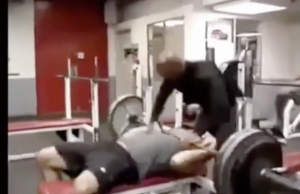 We will start our tips to avoid injuring your body with the bench press. The bench press is a classic lift in bodybuilding because it is one of the most essential ways of training your chest muscles. When you perform a bench press, your hands should be shoulder- width apart. Grip the barbell firmly with both hands and close your fingers around the bar for maximum control.
Never use a dead man’s grip (suicide grip)
This is when you have your thumb on the same side as your fingers when gripping the barbell to make the lift more challenging. However, I have to emphasize that this open-handed grip has a bad safety track record. In short, there’s always a chance that the barbell will just roll out of your grip and land on your head or neck.
Avoid back arching when you’re performing bench presses
If your back is constantly arching when you lift your barbell off the safety rack, you’re lifting too much. You are in serious danger of dropping the barbell on yourself so I would suggest that you reduce the weight that you are pressing and re-learn proper form before starting another complete set.
Squats Gone Wrong
Next in our tips to avoid injuring your body article is the squat. The is one of the most important movements that you can ever learn because it strengthens the lower region of your body effectively. You will find squats in many fitness and bodybuilding books because it is one of the most effective ways to work out the hips and calves.
What’s the common issue with squats?
The problem with many beginning fitness enthusiasts is that they squat incorrectly which directly increases the risk of knee injury. If you’re holding weights while performing a squat, you might even fall over!
When performing a squat, keep your legs parallel to each other and be mindful of your knees. Unless your an “Olympic” weightlifter, your knees should never go past your toes line when you go down. Olypic weightlifters use a narrow stance so there knees naturally extend out past there toes. You should use a stance with your feet slightly wider than your shoulder. Extending your knees out past your toes in this stance is never a good idea as, you run the risk of tearing ligaments and joints in your knees.
Squat down slowly and stop an inch or two before hitting “toe line.”
You can enforce proper form while squatting by imagining that there was a chair behind you and you’re sitting on the chair as you go down. You can also perform basic wall squats add link here to train your back and legs to remain steady when squatting.
Pull Down Madness
Last thing to cover in our tips to avoid injuring your body are “Pull downs” which are exercises performed using a cable machine. They’re great for exercising the back muscles. However, if your form is imperfect then you may also end up injuring yourself instead of building back strength.
When you are performing pull-downs, your back must be kept straight and you must make an effort to remain in the same position throughout the movement. If you feel yourself swaying back and forth, constantly coming out of your seat you’re performing the exercise with too much weight and risking pulling a muscle. Lower to a weight you can control with proper form.
What do you think of my tips to avoid injuring your body? Comments below are always appreciated!
Ready to stop guessing and start transforming? Get all 13 complete fitness resources—including the Keto Recipe Videos—in the All-In-One GOT2MANUP Fitness Blueprint today and finally start your reboot
Sources
-
American Council on Exercise (ACE) guide to safe strength training and injury prevention
https://www.acefitness.org/education-and-resources/lifestyle/blog/7225/5-tips-to-help-you-avoid-weightlifting-injuries/ -
Mayo Clinic overview of common weightlifting injuries and how to prevent them
https://www.mayoclinic.org/healthy-lifestyle/fitness/in-depth/weight-training/art-20045842 -
National Institutes of Health research on biomechanics and injury risk during resistance training
https://www.ncbi.nlm.nih.gov/pmc/articles/PMC6007963/ -
Harvard Health explanation of proper lifting technique and how it protects joints and muscles
https://www.health.harvard.edu/staying-healthy/exercise-and-injury-prevention -
Cleveland Clinic tips on warming up, mobility work, and proper progression to reduce injury risk
https://health.clevelandclinic.org/the-importance-of-warming-up-before-exercise/
FAQs
Q: What are the best tips to avoid injuring your body while weightlifting?
A: The best tips to avoid injuring your body while weightlifting include using proper form, warming up thoroughly, progressing gradually, balancing muscle groups, and listening to your body when it signals fatigue or pain.
Q: Why is warming up important before lifting weights?
A: Warming up increases blood flow to muscles, improves joint mobility, and prepares your nervous system for effort, all of which help lower the risk of muscle strains and joint injuries.
Q: Does lifting heavier weights always increase injury risk?
A: Not necessarily. Injury risk goes up when you increase weight too quickly or sacrifice technique. Progress should be steady and controlled, not rushed.
Q: How can poor form lead to weightlifting injuries?
A: Poor form places stress on joints and muscles unevenly, which can strain connective tissue and lead to overuse injuries. Proper technique distributes load safely across muscles.
Q: Should I use a spotter or trainer to help prevent injuries?
A: Yes. A spotter or experienced trainer can correct form, help with challenging reps, and provide safety when lifting heavier weights, reducing the likelihood of accidents.
Q: Can flexibility and mobility work reduce the risk of injury?
A: Yes. Improved flexibility and joint mobility help you move through safe ranges of motion, stabilize positions under load, and reduce strain on muscle and connective tissue.




The imaginary chair idea which you gave for the squats is really nice. I started with squats by leaning my back to a wall and gradually going down into a sitting position.
You are right dude. If we are arching when we lift the barbell from the safety rack, then that means we are lifting too much more weight than we should. This is the one thing our instructor never fails to mention at least once everyday.
More than anything else I get surprised when people get injured from using a bench press. And all of that are for the same reason which is they lose the grip due to sweaty hands. I mean, come on.. have at least the minimum common sense to wipe the sweat off your hands.
The newbies always try to get good muscles like just with a snap. They always tend to life over-weights for that and end up injuring themselves.
I have saved at least 5 such boys from getting a serious injury due to lifting overweights.
“Dead man’s grip”.. Damn that thing. That day I was working out at gym with other people as usual. One man there was lifting the barbells with that dead man’s grip..he does that everyday and nothing new about it. But that day, he lost grip and the barbell went right on his neck. Man was dead on the spot.
I did not know about the problems that can be caused due to squats, though I have been doing squats. Thank you for the heads up. I will keep these things in mind next time I do a squat.
Great things that you have shared over here. Keeping yourself away from injury are as important as getting in a good shape. Thank you for sharing this information.
No matter how confident I am about my strength, I always have someone beside me for the support whenever I am trying to do weight lifts. I have never got an injury due to lifting over-weight till date, but I don’t wanna talk chances.
Ahhh.. bad memories come to me when I see the work squat.. Two years back during my regular workout, I tried holding weights while doing squats. I almost broke my knee that day :(
Lifting too heavy weights can do more bad than good. It is very important to know how much to lift or it can cause injuries. The neophytes tend to do this mistake often.
I have seen many people, mostly newbies, getting an injury because of the pull downs. The newbies are too eager and over-excited to gain muscles quick and put on too much weight, on pull downs, than what they can handle.