
Hypertrophy-vs-Failure-Training – Hypertrophy Lifting Is Better Than Lifting to Failure
Introduction To Hypertrophy-Vs-Failure-Training
Have you ever wondered about hypertrophy-vs-failure-training? Are you grinding every rep until failure, hoping for maximum muscle growth? What if I told you there’s a better way, one that builds just as much muscle while keeping your joints healthy?
If you’re a man over 40, your workouts need to be strategic. Pushing yourself to failure every session can lead to burnout, increased joint pain, and longer recovery times. Instead, hypertrophy-based training provides the muscle growth you want without the unnecessary strain.
In this post about hypertrophy-vs-failure-training, we’ll explain why hypertrophy lifting beats failure training for long-term muscle gains, the science behind it, and how you can optimize your workouts for maximum growth.
What Is Hypertrophy Training?
Hypertrophy training increases muscle size by targeting specific rep ranges, volume, and intensity. Typically, it involves:
- Reps: 8-12 per set
- Sets: 3-5 per muscle group
- Rest Time: 30-90 seconds between sets
- Load: 60-85% of your 1-rep max
- Tempo: Controlled, focusing on time under tension (TUT) G2MU programs vary between 40-60 sec TUT in most exercises

Comparing hypertrophy-vs-failure-training, unlike failure training, which pushes every set until you can’t lift another rep, hypertrophy training prioritizes consistent muscle stimulation without overloading your joints.
The Science: You Don’t Need to Lift to Failure to Grow
Many believe you must train to absolute failure to maximize muscle growth. However, research has shown otherwise:
Study #1: Failure vs. Non-Failure Training (Izquierdo et al., 2006)
- Two groups trained under identical conditions, one to failure, one stopping short.
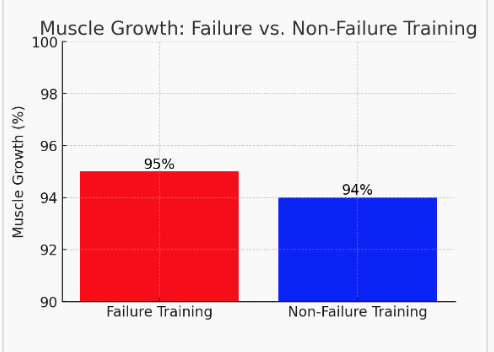
- Both groups saw similar muscle growth, but the failure group experienced more fatigue and longer recovery times.
Study #2: Systematic Review (Vieira et al., 2021)
- Reviewed multiple studies comparing failure vs. non-failure training.
- No significant differences in muscle hypertrophy, proving failure training isn’t necessary.
Study #3: Meta-Analysis (Grgic et al., 2022)
- Analyzed various training protocols.
- Non-failure training produced the same muscle gains with less fatigue and injury risk.
Key Takeaway: You don’t have to train to failure to maximize muscle growth. Instead, focus on volume, progressive overload, and recovery.
How Hypertrophy Training Protects Your Joints
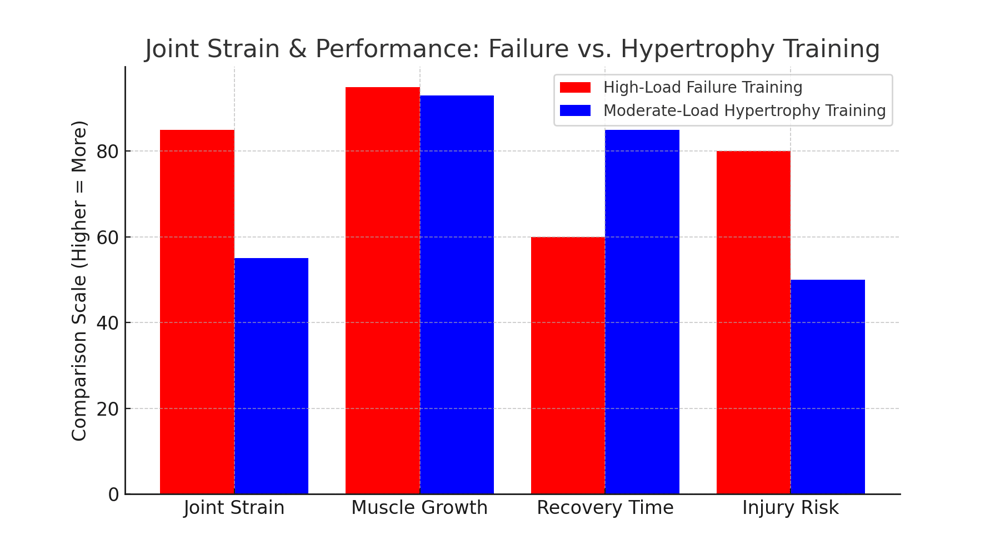
As we age, our joints become more susceptible to wear and tear. Training to failure consistently increases joint strain and inflammation, making long-term fitness unsustainable.
On the other hand, hypertrophy training builds muscle while preserving joint health. Here’s how:
Study #4: Blood Flow Restriction (BFR) Training Research
- Low-load training with blood flow restriction leads to significant muscle growth.
- Muscles grow without high mechanical stress, reducing joint wear.
Study #5: Eccentric Training Studies
- Eccentric (lengthening) contractions generate high force with low energy cost.
- Muscle growth occurs with less strain on joints.
Study #6: Low-Load High-Volume Training (Frontiers in Physiology, 2022)
- I found high-rep, low-load training to be** as practical as heavy lifting**.
- Less joint stress, same muscle gains.
Key Takeaway: Hypertrophy training stimulates muscle growth without damaging joints by using controlled reps and optimal volume**.**
How to Structure Your Hypertrophy Workouts
1. Choose the Right Exercises
Focus on compound and isolation movements to maximize muscle engagement while reducing unnecessary joint strain.
Best Exercises for Hypertrophy-Vs-Failure training
- Upper Chest: Incline Dumbbell Press, Low To High Cable Chest Press
- Chest: Barbell Flat Bench Press, Chest Press Machine
- Lower Chest: Dumbbell Pullover, Decline Bench Barbell Press
- Back: barbell Stiff Leg Deadlift, Bent Over Straight Arm Cable Pushdown
- Side Delts: Lateral Raises, Seated Shoulder Press
- Front Delts: 75° Incline Bench DB Front Raise, Free Motion Machine Cable Front Raise
- Rear Delts: 75° Incline Bench DB Y Raises, Inverted Rows
- Biceps: Back Against The Wall EZBar Bicep Curls, Preacher Curl, Drag Curls
- Triceps: Rocking Rope Pushdowns, EZ Bar California Press
- Quads: Smith Machine Front Squats, Seated Leg Extensions
- Hams: Leg Press, Bulgarian Split Squats
- Core: Hanging Leg Raises, Cable Crunches
2. Use Progressive Overload Without Failure
Progressive overload is key to muscle growth. But instead of training to fail, apply these methods:
- Increase reps gradually: Add 1-2 reps each week until you hit the upper range, then increase weight.
- Slow down tempo: More time under tension enhances muscle fiber recruitment. Go at least four seconds, I prefer five, sometimes six.
- Focus on form: Proper form is the most important thing you can do to build muscle and prevent injury.
3. Optimize Your Recovery
Recovery is just as important as lifting. Here’s how to speed up muscle repair:
- Sleep: Aim for 7-9 hours per night.
- Nutrition: Consume one gram of protein per pound of body weight.
- Hydration: Drink a gallon of water daily to support muscle function. It’s also a good food deterrent.
- Mobility Work: Daily stretching and Rolling for joint health.
Will We Ever Use Failure Training?
At Got2ManUp, our workouts focus on hypertrophy, but failure training will be included selectively. Here’s when it’s useful:
✅ Final set of an exercise (e.g., last set of bicep curls)
✅ Bodyweight movements (push-ups, dips)
✅ Advanced lifters seeking variety
We don’t train to fail every set, we train smart for long-term results.
Final Thoughts On Hypertrophy-Vs-Failure-Training:
The Smarter Way to Build Muscle After 40
If you’re a man over 40, the goal isn’t just muscle size, it’s strength, health, and longevity. Hypertrophy lifting gives you maximum muscle growth with minimum joint stress, keeping you in the gym for decades.
Following the strategies above, you can build muscle effectively without burning out or dealing with unnecessary injuries.
Join the Got2ManUp Movement
Want to take your training to the next level? Get lifetime access to exclusive workouts, live Q&As, and community support. Purchase the Got2Manup Fitness BluePrint for only $37 Click her to start today
📲 Follow us on Facebook for fitness tips!
🔥 Bookmark this blog and share it with a friend who needs this knowledge!
Stay strong, train smart, and Man Up! 💪
Sources (with links)
-
Is Resistance Training to Muscular Failure Necessary? This 2016 review discusses whether reaching muscular failure is required for strength or hypertrophy, concluding that it may not be necessary. PMC
-
Effects of resistance training to muscle failure vs non‑failure on muscular strength and hypertrophy A 2020 study showing that, when volume is matched, training to failure or not yields similar hypertrophy and strength gains. PMC
-
Influence of Resistance Training Proximity-to-Failure on Skeletal Muscle Hypertrophy: A Systematic Review with Meta-analysis A 2023 meta‑analysis finding no clear advantage of momentary failure over non‑failure training for hypertrophy; suggests proximity‑to‑failure may not be the dominant factor. SpringerLink+1
-
Effect of resistance training performed with different set termination criteria on muscle hypertrophy in high-load protocols This 2021 study found that for high‑load resistance training, reaching failure did not seem to be essential for hypertrophy. MDPI
-
Effects of resistance training performed to repetition failure or non-failure on muscular strength and hypertrophy: Systematic review and meta-analysis A 2022 meta-analysis that concludes training to failure does not reliably produce greater strength or hypertrophy than non-failure when volume is equal. ScienceDirect+1
FAQ
Q1: What’s the difference between hypertrophy training and failure‑training?
Hypertrophy training focuses on building muscle size through structured resistance training (volume, load, frequency). Failure‑training means pushing sets until you can’t complete another rep. The two overlap, but you don’t always need to train to failure to build muscle.
Q2: Do I need to lift to failure to grow muscle?
Not necessarily. Research shows that when overall volume is matched (sets × reps × load), similar gains in muscle size and strength can occur whether you reach failure or stop short.
Q3: Does failure‑training offer any benefits at all?
For some people, especially experienced lifters, training closer to failure can help recruit more muscle fibers and may enhance hypertrophy slightly. But it’s not a guarantee, and any benefit must be weighed against fatigue and recovery demands.
Q4: Are there downsides to training to failure frequently?
Yes. Constantly pushing to failure can increase fatigue and recovery time, and may raise risk of overtraining or injury. It’s likely not sustainable week after week, especially for older or intermediate/advanced trainees.
Q5: What’s a smart way to structure training for hypertrophy without overdoing failure‑training?
Use controlled volume and load: plan sets and reps so you reach near failure (leaving a rep or two “in reserve”) rather than hammering failure every time. Rotate training cycles: some days emphasize heavy, lower‑rep sets (for strength), others moderate reps/volume for size, with occasional failure or near‑failure sets for stimulus.
Q6: Does this apply to men over 40 (my audience)?
Yes, and likely even more so. As you age, recovery becomes more important. Matching volume and allowing for recovery may be more effective and safer than pushing to failure all the time.
Q7: Can I still transform my body (gain size, lose fat, build strength) without failure‑training?
Absolutely. Many studies show that non-failure resistance training, if done consistently with the right volume, load, and nutrition, leads to significant muscle growth and strength gains.